
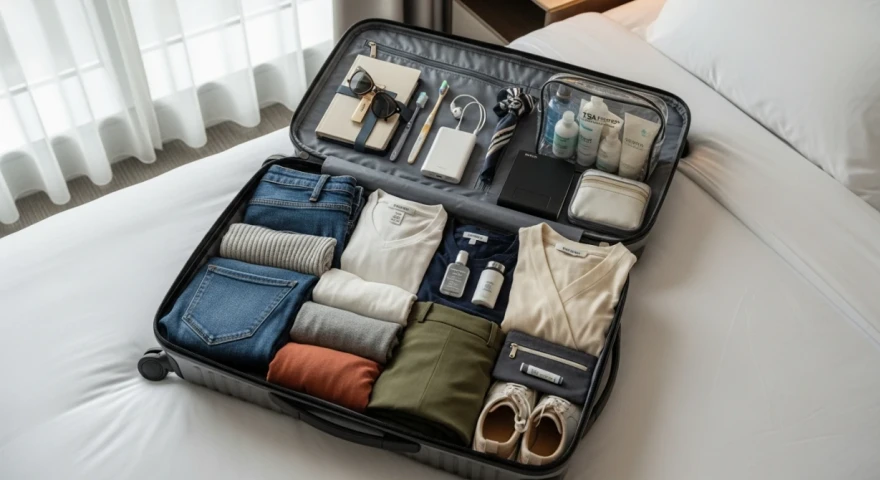
Weekend Getaway Packing Guide: Fit the Right Travel Bag in One Smart Plan
Pack for a weekend in one bag by limiting yourself to two versatile outfits, rolled clothing, grouped essentials, and a quick-access pouch. Use a go/no-go check before leaving.
Most people overpack for two nights and still forget the one thing that slows the whole trip down, easy access to essentials. Short trips matter more now because they are often squeezed between workdays, family plans, and tight check-in windows, so your setup has to be fast, light, and deliberate.
A solid weekend getaway packing guide starts with one rule. Every item needs a job, and every job needs a place. If your loadout cannot be carried comfortably, opened quickly, and repacked in under ten minutes on the return, it is not ready.
🧭 Define the goal and your measurable readiness standard
The goal is not to bring less for the sake of minimalism. The goal is to cover two to three days with one carryable setup that keeps clothes organized, protects essentials, and avoids last-minute reshuffling.
Use measurable checks instead of guessing. If you cannot lift your packed gear with one hand, find your phone and ID in five seconds, and close everything without sitting on it, you have packed beyond the practical limit.
- Ready: One main carry item holds clothing, toiletries, chargers, and sleepwear with no loose overflow.
- Ready: Passport, boarding pass, phone, and wallet sit in an easy-access pouch or crossbody bag.
- Ready: You have one backup outfit combination, not three separate “just in case” looks.
- Not ready: Shoes are taking more space than clothing.
- Not ready: You need a second tote just for chargers, snacks, or documents.
Rolling clothes instead of folding them can reduce wrinkles and free up room, while packing cubes improve organization and help use space more efficiently on short trips.
Weekend packing best practice
✅ Pack by priority buckets, not by room in your house
The easiest way to stay within one-bag limits is to sort by necessity before anything enters the zipper. This keeps impulse items out and makes trade-offs obvious.
Must-do items
These are the non-negotiables. If one of these is missing, the trip becomes inconvenient or expensive to fix.
- Core clothing: One travel outfit, one sleep set, underwear, socks, and one spare top.
- Versatile layers: Neutral pieces that can be worn in more than one outfit combination.
- Personal essentials: ID, payment method, phone, medications, keys, and charger.
- Toiletries: Only the items you will actually use over two or three days.
- Main carry choice: Pick a compact backpack, crossbody, or zip-top style that matches the trip format and keeps weight stable.
Should-do items
These improve comfort and speed but are not trip-critical. Add them only after the first group is packed and the closure still works smoothly.
- Packing cubes: Use them to separate clean clothes, laundry, and small items.
- Second pair of footwear: Bring only if the trip genuinely includes a different activity or dress requirement.
- Light weather buffer: Add one layer that works indoors and outdoors.
- Compact personal pouch: Keep your high-access items together for stations, terminals, or hotel check-in.
Nice-to-do items
This bucket is where most overpacking starts. If these do not fit without pressure, leave them out.
- Extra outfit variety: One more look is enough, not a full wardrobe swap.
- Bulky grooming tools: Skip anything that solves a low-probability problem.
- Entertainment extras: Bring one device and one charging cable set, not duplicates.
| Priority bucket | What belongs here | Keep or cut rule |
|---|---|---|
| Must-do | Clothes, toiletries, documents, phone, medication, charger | If missing, replace immediately |
| Should-do | Packing cubes, weather layer, access pouch, optional footwear | Keep only if the main compartment still closes easily |
| Nice-to-do | Style extras, redundant gadgets, low-use items | Cut first when space gets tight |
⏱️ Execution order and timing windows that prevent last-minute mistakes
Packing order matters because bulky items distort your judgment. Start with the trip structure, then add clothes, then small support items, then your high-access essentials last.
- 24 hours before departure: Confirm trip context, number of nights, dress level, and whether you need city, work, or casual use.
- 15 minutes after that: Build two complete outfits from versatile clothing in neutral colors, then stop.
- Next 10 minutes: Roll clothes instead of folding them, then place them into packing cubes or tight zones.
- Final 5 minutes: Add toiletries, cable, keys, wallet, and documents in reachable pockets.
- Go check: Carry the packed setup for one minute indoors and test opening, grabbing, and closing.
This order reduces the usual trap of filling space first and deciding later. It also shows early whether your chosen carry style is right for the trip.
Which bag style works best for a weekend trip
The right format depends on how you move, not just how much you own. For train platforms, airports, and city walking, hands-free carry usually wins.
| Bag type or model | Best use | Why it suits a weekend trip |
|---|---|---|
| Crossbody or long-strap style | City breaks, airports, quick access | Keeps documents and phone close while moving |
| Zip-top men's bag | Short work-led trip | Simple closure and cleaner organization for essentials |
| Travel bags category | General weekend use | Built for short-duration packing without overcomplication |
| Arctic Hunter B0388 Backpack – Blue | Short casual getaway | Backpack format supports balanced carry and easy movement |
| Bange FM230 Backpack – Black | Smart weekend city trip | Works when you want a cleaner, more structured look |
| Bange BG6625 Backpack – Black | Heavier short-trip load | Useful when you need a bit more organized capacity |
| Arctic Hunter B00111C Business Laptop Backpack – Black | Work plus overnight stay | Good fit when a laptop is part of the loadout |
| Bange 3065 Backpack | Flexible two-night packing | Available in multiple colors and suited to practical carry |
| Arctic Hunter B00690 Backpack – Black | Simple short break | Backpack style keeps weight stable on the move |
If you want one setup that can also serve daily use after the trip, an everyday rucksack is often the easiest transition. If your trip includes frequent document checks, pair your main carry with a slim crossbody for grab-and-go essentials.
🛡️ Risk controls and the critical misses that ruin short trips
Weekend packing fails less from lack of space and more from poor access. The common miss is burying important items under clothing, then unpacking half your load in a line or lobby.
- Control access: Keep passport, boarding pass, and phone in one small pouch or crossbody section.
- Control wrinkles: Roll soft garments and place structured pieces flat on top.
- Control clutter: Use cubes or fixed zones so cables and toiletries do not spread through the compartment.
- Control outfit creep: Pack clothing that mixes into at least two looks.
- Control weight: Do not let shoes, denim, or duplicate grooming items dominate the load.
Another frequent problem is choosing the wrong type of carry item. A handbag or shopper can work for a light overnight stay, but once the load includes shoes, a layer, and toiletries, a backpack or dedicated travel bag usually carries better and repacks faster.
Two realistic packing scenarios
A Friday-to-Sunday city break usually needs one walking outfit, one dinner-ready option built from the same neutral pieces, sleepwear, toiletries, and a charger. When packed with rolled clothing and cubes, most travelers can keep this within one backpack plus an easy-access pouch.
A short work trip with one meeting changes the loadout. You need a cleaner bag shape, a protected section for tech, and fewer casual extras, which makes a business-style backpack or zip-top men’s bag the safer choice.

📋 Go or no-go readiness checklist before you leave
This is the final decision point. If you fail any no-go item, remove something or reorganize before departure.
- Go: Main carry closes without strain and keeps its shape when lifted.
- Go: You can reach phone, ID, and wallet without opening the clothing compartment.
- Go: Every clothing piece works in at least one complete outfit.
- Go: Toiletries are limited to the trip length and grouped together.
- Go: Charger and key items are in one known location.
- No-go: You added duplicate “backup” items for the same job.
- No-go: The setup requires a second loose carrier for overflow.
- No-go: You cannot repack it quickly after the first night.
🎒 Practical recommendations that save space without sacrificing usefulness
These are the moves that consistently improve short-trip packing. Each one solves a specific failure point rather than adding theory.
- Build around two outfits: Start with one worn outfit and one packed outfit, then add only one layer if weather calls for it.
- Roll soft garments: This usually reduces wrinkles and opens more room for compact packing.
- Use packing cubes by function: One for clothing, one for underlayers, one for small loose items.
- Keep access separate: Put documents and phone into a small side pouch or crossbody so security checks move faster.
- Choose neutral clothing: Fewer colors create more combinations and cut unnecessary extras.
- Match the bag to the trip: Backpacks suit moving days, while structured work styles suit business-led weekends.
If you are shopping for a short-trip carry option, threebirds offers practical categories such as travel bags, work bags, shopper styles, handbags, and men’s leather or zip-top options. Keep the choice tied to movement, access, and load shape rather than appearance alone.
A good one-bag setup is strict but not uncomfortable. Pack for the plan, test for access, and cut anything that does not improve the trip. That approach keeps your load light, your clothes usable, and your first hour after arrival much easier. If you need a smarter carry option, browse threebirds for a short-trip bag that matches how you actually travel.
How many outfits should I pack for a weekend trip?
Two complete outfits plus sleepwear is usually enough for two to three days. Neutral pieces help those items cover more than one setting.
Is rolling clothes better than folding for a short trip?
For most soft items, yes. Rolling tends to save room and can help reduce visible creasing.
What should stay easiest to reach during transit?
Your phone, ID, payment method, and any boarding document should stay in a separate quick-access area. That prevents repeated unpacking in public spaces.
When does a backpack make more sense than a shopper bag?
Choose a backpack when you are carrying shoes, a layer, toiletries, or tech. It spreads weight better and usually repacks faster on the return trip.
Do packing cubes really help on a two-night trip?
Yes, because they keep categories separated and stop small items from drifting through the main compartment. They also make repacking much quicker.
What is the clearest no-go sign before leaving?
If your main carry will not close easily or you need a second loose bag for overflow, your setup is too large. Remove duplicate or low-use items first.
 How to Build a Capsule Wardrobe for Travel That Works Anywhere in the World
 Travel Accessories Worth Packing in 2025: Essentials That Truly Upgrade Every Trip