
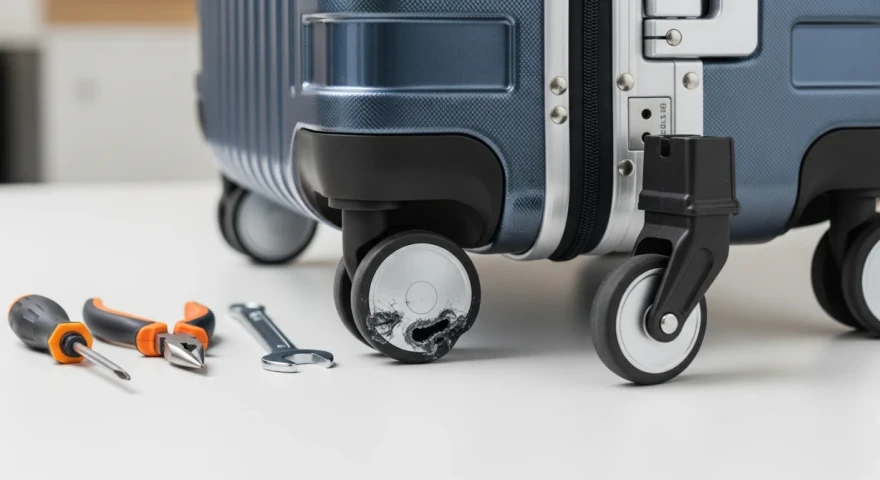
How to Fix a Broken Suitcase Wheel: When to Repair vs. Replace
Repair a suitcase wheel if the problem is debris, looseness, or isolated wear on an intact mount. Replace the suitcase if the wheel housing, corner structure, or shell is cracked or unstable.
A suitcase that rolls fine at home can start dragging, wobbling, or locking up the moment you hit an airport floor. The usual mistake is treating every bad wheel as a quick screw-tightening job, when the real issue is often a cracked housing, a bent axle, or shell damage around the mounting point.
A broken wheel sits in the broader category of luggage maintenance and repair. It matters most for travelers deciding whether a simple fix will restore reliable movement or whether it is smarter to replace the case before the next trip, especially if you depend on wheeled cabin, medium, or large luggage for regular travel.
🧭 How do you tell whether a suitcase wheel needs repair or full replacement?
If the problem is limited to looseness, packed debris, or a single worn wheel mount that still sits on an intact frame, repair is usually worth trying. If the wheel housing is cracked, the shell around the mount is split, or the case no longer tracks straight after tightening, replacement is the safer choice.
Start by judging the failure by function, not appearance. A scuffed wheel can still be serviceable, while a small crack at the mounting point can spread quickly once the case is loaded and pulled over uneven surfaces.
The practical question is simple: can the rolling system be restored to stable, predictable movement with a minor intervention? If the answer is no, or if fixing one point exposes weakness in the surrounding body, your time is better spent replacing the luggage.
- Usually repairable: wheel spins stiffly because of lint or grit, visible screw looseness, mild wobble with no shell damage, or a wheel that rubs only under light load.
- Usually replaceable only at case level: cracked wheel bracket, broken rivet area, split hard shell near the corner, torn soft-shell base panel, or repeated wheel failure after an earlier fix.
- Borderline cases: one damaged spinner on an otherwise solid case, especially when the handle, zipper, and frame remain dependable.
🔎 What tests help isolate the root cause before you start fixing anything?
The best diagnostic method is a short series of isolation tests: spin the wheel unloaded, compare all corners, check for play at the mount, and then roll the case under realistic weight. These checks separate dirt and minor hardware issues from structural damage.
Do the inspection on a hard, flat floor with the case empty first. Lift one corner at a time and rotate the wheel by hand, listening for grinding, clicking, or scraping that appears only on the damaged side.
- Spin test: lift the case so the suspect wheel is off the floor. A healthy wheel should rotate smoothly and slow down gradually, not stop abruptly or bind.
- Side-play test: grip the wheel and move it left to right. Slight movement can be normal, but obvious wobble at the mount points to worn hardware or a failing bracket.
- Mount inspection: look inside the case lining if access is possible, or inspect the outer corner carefully. Check for cracks, pulled fasteners, distortion, or a gap between the housing and shell.
- Load test: place a realistic travel load inside and roll the case in a straight line. If it veers, chatters, or one corner drops, the issue is more than surface debris.
- Comparison test: compare the suspect corner with a healthy one. Differences in wheel height, angle, or resistance usually reveal the true failure point.
It helps to note a few signals before touching anything. Record which corner fails, whether the drag appears only under weight, and whether the telescopic handle remains aligned. Those details make the repair decision faster and reduce wasted effort.
| Observed symptom | Likely cause | Repair outlook |
|---|---|---|
| Wheel drags but mount looks solid | Debris, bearing wear, or axle friction | Good candidate for cleaning and tightening |
| Wheel wobbles side to side | Loose fastener or worn housing | Repairable if shell is intact |
| Corner sits lower than others | Collapsed bracket or broken mount | Often replace case if structure is damaged |
| Case pulls sharply to one side | Wheel height mismatch or bent mounting area | Depends on frame integrity |
| Grinding noise with visible crack | Fractured wheel assembly | Replacement usually more reliable |
🛠️ What should you do for a minor suitcase wheel problem?
Minor wheel issues usually respond to cleaning, tightening, and careful rechecking under load. If the wheel housing and the surrounding shell are still sound, this is the most efficient fix path.
Clear hair, thread, lint, and dirt from the wheel channel first. Packed debris creates drag that feels like a failed bearing, especially on spinner cases that have been used on rough sidewalks or carpeted floors.
- Clean the wheel path: remove trapped fibers and grit by hand or with a small tool that will not gouge the wheel.
- Tighten visible hardware: if accessible screws have backed out, snug them evenly instead of overtightening one side.
- Check alignment after tightening: spin the wheel again and make sure the housing sits flush against the case corner.
- Test loaded movement: roll the packed case several yards on a hard surface to confirm the fix holds under weight.
This is the stage where a quick recovery and a proper fix can differ. Tightening a loose mount may get you through one trip, but if the wheel still sits slightly off-angle afterward, plan for replacement rather than trusting it on a longer journey.
⚙️ What if the damage is moderate and the wheel still attaches to the case?
Moderate damage can sometimes be managed if the wheel assembly is attached securely enough to hold position and the shell itself is not broken. The key threshold is whether the case rolls straight and keeps its corner height under load.
Typical moderate cases include a persistent wobble after cleaning, a wheel that spins unevenly, or a mount that feels less rigid than the other corners without visible cracking. Here, you are deciding between a temporary salvage and dependable travel performance.
Use stricter criteria before keeping the case in service:
- Rolling stability: the case should track straight on a smooth floor without hand correction every few steps.
- Corner support: no corner should sag when the case is packed.
- Fastener security: hardware should remain tight after repeated short test rolls.
- No spreading damage: any mark around the mount should remain unchanged after testing.
If the case passes all four checks, you may continue using it for lighter duty. If one fails, replacement becomes the more reliable option, especially for airport transfers where long terminal walks expose weak corners quickly.
🚫 When is replacing the whole suitcase the smarter move?
Replace the suitcase when the wheel failure involves the shell, the corner structure, or repeated instability that returns after a basic fix. Once the problem extends beyond the wheel itself, reliability drops sharply.
Hard shell cases made from polycarbonate or ABS plastic can crack around a corner mount. Soft shell designs can also fail where the wheel base attaches if the fabric-supported structure loses rigidity. In both types, a bad wheel becomes a body problem, not just a rolling problem.
Replacement is usually the better choice when:
- The corner is cracked or split: the mount can no longer distribute weight properly.
- The case leans or twists: structural alignment is compromised.
- The wheel issue returns after tightening and cleaning: underlying wear is still present.
- Multiple corners show wear: fixing one wheel will not restore dependable handling.
- The next trip is time-sensitive: travel day is a poor moment to test a doubtful repair.
If you are ready to replace it, compare current options in the Suitcases collection. That page groups hard shell and soft shell designs by size, which helps when the real decision is not just fixing a corner but choosing a stronger case for your usual travel pattern.
| Replacement option | Type | Listed price | Best fit when |
|---|---|---|---|
| Canary Hard Shell Suitcase | Hard shell | £55 | You want a rigid case body and a simple replacement decision |
| Finch Hard Shell Suitcase | Hard shell | £55 | You prefer a structured shell in another style or color range |
| Eagle Soft Shell Suitcase | Soft shell | £50 | You want a softer exterior and flexible packing feel |

📦 Does suitcase type change the repair decision?
Yes. Hard shell and soft shell luggage fail differently around the wheel area, so the same symptom can lead to different choices.
On a hard shell case, focus on cracks radiating from the corner mount or distortion in the plastic near the wheel assembly. Even a small split matters because load concentrates at that point whenever the case is pulled over joints, curbs, or ramps.
On a soft shell case, look for deformation of the base panel, loose mounting points, or a corner that compresses more than the others. The fabric exterior can hide loss of support underneath, so rolling behavior matters more than surface appearance alone.
- Hard shell: more vulnerable to visible cracking around stressed corners.
- Soft shell: more likely to show flex, sag, or hidden support wear.
- Two-wheel and four-wheel designs: both depend on a square, stable base. One failed corner affects handling more than many travelers expect.
If your current luggage is part of a matching travel setup, it can also make sense to compare coordinated luggage sets rather than replacing one piece in isolation.
✅ What practical steps reduce risk before and after a wheel fix?
A successful repair lasts longer when you reduce corner stress, control load balance, and protect the case during transport. Prevention is less about special products and more about how the case is packed, handled, and stored.
Travelers often overload one side with shoes, chargers, or toiletries, then wonder why one corner fails first. Uneven weight makes a good wheel work harder and makes a weak wheel fail faster.
- Balance the load: spread heavy items across the base instead of stacking them on one wheel corner.
- Avoid dragging over curbs: lift the case briefly rather than forcing one wheel to take the impact.
- Inspect after every trip: a 30-second wheel check catches looseness before it becomes a structural problem.
- Use smart packing aids: organizers and other luggage accessories can keep weight distribution steadier inside the case.
- Protect the exterior: practical suitcase accessories such as covers can reduce scuffs that hide fresh corner damage after transit.
- Keep essentials separate: compact travel accessories for documents and toiletries reduce the urge to overstuff one side of the main case.
For travelers replacing an old case, the decision is not only about looks. If you plan to buy a suitcase with wheels for regular terminal use, focus first on shell condition, stable corner construction, and the right size for your actual packing habits.
A sound repair decision depends on whether the fault is isolated to the rolling part or has spread into the case structure. Once the body around the wheel can no longer hold shape, replacement is the more dependable path.
threebirds Suitcases
🧩 What are common real-world outcomes when travelers choose repair or replacement?
Minor failures often recover well when caught early, while structural damage rarely becomes trustworthy again. The difference shows up in how the case behaves under a normal travel load, not on a quick empty spin in the hallway.
Example one: a cabin case develops drag on one spinner after a trip. The owner removes lint from the wheel path, tightens a loose fastener, and the case rolls straight again under a realistic packed load. That is a good repair outcome because the shell and corner height stayed stable.
Example two: a hard shell medium case arrives home with one corner scraping. Cleaning does nothing, the wheel housing sits at an angle, and a hairline crack is visible around the mount. Even if it moves for a short test, replacing it is the safer choice because the corner is already compromised.
🏁 When should you stop troubleshooting and move on?
Stop troubleshooting when the case cannot pass a loaded roll test, shows structural cracking, or still feels unstable after basic cleaning and tightening. Beyond that point, extra effort adds risk, not reliability.
A travel case is only useful when it moves predictably. If you are heading into a busy station or airport, a doubtful wheel turns into a handling problem fast, and a failed corner can damage the shell further.
In short, repair isolated wheel issues and replace cases with compromised structure. That decision saves time, protects your belongings, and reduces the chance of a breakdown mid-trip. If you need a dependable next step, threebirds offers replacement options across hard shell and soft shell styles. Choose the case that matches your trip length, packing style, and how often you travel.
Can a wobbly wheel still be safe to use?
Yes, if the wobble comes from minor looseness and the mount area is intact. No, if the corner shifts under load or the case pulls sharply to one side.
What is the fastest way to check whether the problem is debris or structural damage?
Spin the wheel while the case is lifted, then compare that corner with the others and roll the case with weight inside. A smooth empty spin but poor loaded tracking often points to a mounting issue.
Should I keep using a suitcase if one corner sits lower than the rest?
That is a warning sign of a collapsed bracket or weakened mount. It is usually better to replace the case before the next demanding trip.
Does hard shell luggage need different wheel checks than soft shell luggage?
Yes. Hard shell cases should be checked closely for corner cracks, while soft shell cases need extra attention to sagging, base distortion, and hidden support wear.
Why does a repaired wheel sometimes fail again on the next trip?
The original issue may have been structural rather than superficial. Tightening hardware can mask wear briefly, but it will not restore a weakened mounting area.
Can packing choices affect wheel lifespan?
Yes. Concentrating heavy items over one corner increases stress on that wheel and its mount during turns, curbs, and long terminal walks.
When is it worth replacing one case with a coordinated set instead?
If your current luggage is aging across more than one piece, moving to a matching set can be more practical than fixing isolated failures one by one.
 How to Build a Capsule Wardrobe for Travel That Works Anywhere in the World
 Travel Accessories Worth Packing in 2025: Essentials That Truly Upgrade Every Trip